The PROJECT THRESHER

The Species:
The bigeye thresher, Alopias supercilious, is often caught in the Atlantic as bycatch in pelagic longline fisheries targeting tunas and swordfish.
However, there is still little information available on the biology of this species.
The bigeye thresher shark occurs circum-globally in tropical and temperate seas,
ranging in habitat from oceanic epipelagic to coastal waters, preferring more oceanic and warmer waters than its congener Alopias vulpinus.
It is known to usually bear only two embryos per litter (although cases of up to four embryos may occur), resulting in an extremely low fecundity and consequently,
a very high vulnerability to fishing pressure.
The Shark Specialist Group from the International Union for the Conservation of Nature (IUCN/SSG) considered all members of the genus Alopias as
Vulnerable in global terms (according to the IUCN Red List Criteria), because of their declining populations.
Specifically, the bigeye thresher was considered especially vulnerable to fisheries exploitation, even within the Alopias genus,
due to both its exceptionally low rate of population increase and its epipelagic habitat occurring within the range of many poorly regulated waters.
Additionally, the International Commission for the Conservation of Atlantic Tunas (ICCAT), the inter-governmental body responsible for the
management and conservation of pelagic shark in the Atlantic, has acknowledged that the bigeye thresher is one of the most vulnerable and
least studied of all pelagic sharks, and has therefore been requesting more studies on this species.
Aim:
Given the lack of knowledge on the biology, migrations, habitat use,
population genetics and survivorship of the bigeye thresher shark in
the Atlantic Ocean, there is an urgent need for a study in an
ocean-wide perspective. This project was developed as a means of
filling critical voids in this information needed for enlightened
national and international fishery management and conservation
initiatives. Based on this, the proposed project has three main
objectives/tasks:
1) Determination of life history parameters including age, growth, reproduction and mortality;
2) Application of satellite telemetry tags (PAT) to study long term
movements, habitat preferences and survivorship of these sharks in the
Atlantic Ocean;
3) Population genetics comparing different stocks along the Atlantic Ocean.
Main Results:
Project THRESHER finished in July 2014, and the main scientific results and conclusions were:
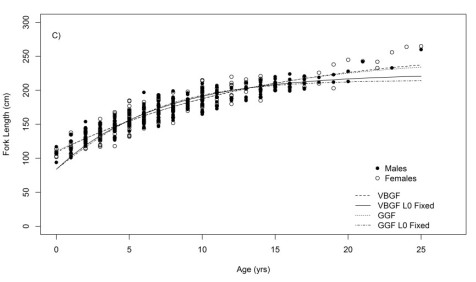
Age and growth: This was the largest age and growth study for A. superciliosus ever carried out in the Atlantic Ocean and allowed,
for the first time, a comparison of the growth patterns between the northern and southern hemispheres.
The main conclusions were that the bigeye thresher has a very slow growth rate, even lower than other thresher shark species,
and that females have lower growth rates and larger asymptotic sizes than the males.
Comparing the two hemispheres, the growth rates are slower in the South Atlantic compared to the North Atlantic.

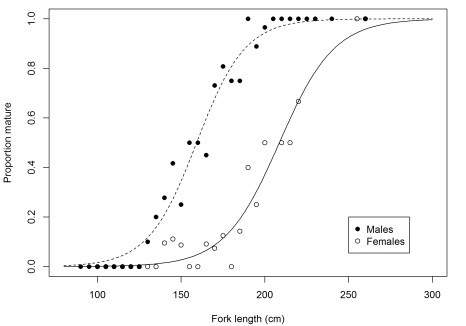
Reproduction: Important reproductive parameters such as the median size-at-maturity were estimated,
and it was determined that this is occurring at approximately 79% of the maximum observed size for females and 61% for males.
It was also possible to confirm the very low fecundity of the species of only two pups per reproductive cycle,
making the bigeye thresher one of the least fecund of all shark species.
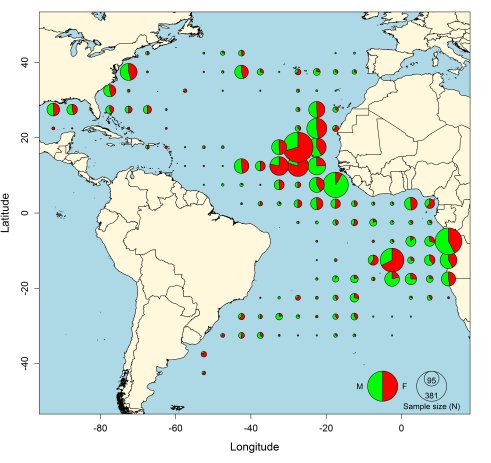
Distribution: An integrated large scale collaborative study of several nations was carried out for the first time aiming
to determine the size structure of the species along the Atlantic and possible mating and nursery areas.
The most significantly different region was the tropical north Atlantic where specimens tended to be smaller and the
proportion of juveniles higher than in other regions. Three possible nursery areas were identified along the Atlantic,
specifically in the tropical northeast Atlantic and equatorial waters closer to the African continent,
in the tropical northwestern Atlantic in areas closer to the Caribbean Sea and Florida, and in the southwest Atlantic closer to the Rio Grande Rise.
In this study a model was also created to calculate the odds-ratios of capturing more juveniles in the various regions/seasons combinations and the
results can now be used to provide management advice on the more sensitive areas for the species.
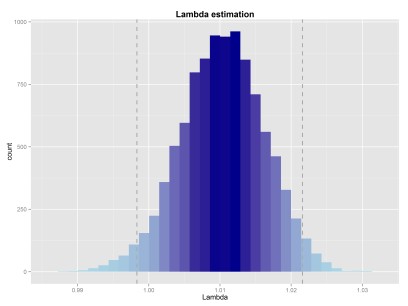
Population dynamics: With the stochastic population dynamics model that was created using the estimated life history parameters,
it was possible to conclude that the bigeye thresher shark has one of the lowest intrinsic growth rates of any pelagic shark,
with annual population increases of around 1%. This is therefore a species extremely vulnerable to fishing pressure,
with population collapses tending to occur even at relatively low levels of mortality.
Additionally, with the calculated model elasticities it was concluded that conservation efforts should be focused mainly on the survival of the juveniles,
as those are the stages that can contribute more for the increase in the population growth rates.
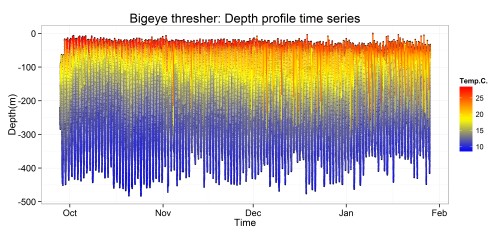
Satellite telemetry: This study was the most comprehensive satellite telemetry study ever carried out for this species and allowed,
for the first time, a comparison on how the two sexes and the different maturity stages (adults and juveniles) are using the habitat.
The main conclusions were that the species presents a strong diel movement pattern, with most of the daytime spent at considerable depths and the night
time period spent closer to the surface in shallower waters. Additionally, differences were also detected on how the adults and juveniles distribute
and use the habitat along this diel movement pattern.
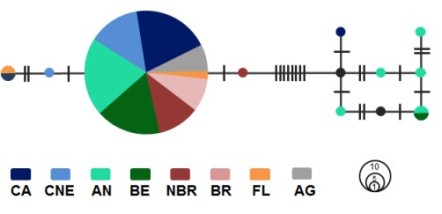
Population genetics: Samples from widespread locations along the Atlantic as well as from the SW Indian Ocean were analyzed and studied.
The main conclusions were the lack of divergence found between the regions that support the hypothesis of panmixia with consequent
absence of historical population structure in the Atlantic.
Additionally, it was discovered the existence of two distinct genetic lineages, with one that is common and widespread and one that is rare
and found only in the regions closer to the African continent.
Scientific papers:
Coelho R., Fernandez-Carvalho J., Lino P.G., Santos M.N. 2012.
An overview of the hooking mortality of elasmobranchs caught in a swordfish pelagic longline fishery in the Atlantic Ocean.
Aquatic Living Resources, 25: 311-319.
click
here for journal website
Fernandez-Carvalho, J., Coelho, R., Erzini, K., Santos, M.N. 2011.
Age and growth of the bigeye thresher shark, Alopias superciliosus, from the pelagic longline fisheries in the tropical northeastern Atlantic Ocean,
determined by vertebral band counts. Aquatic Living Resources, 24: 359-368.
click
here for journal website
Under revision. Age estimation and growth modeling of the bigeye thresher shark in the Atlantic Ocean.
Under revision. Distributional and reproductive aspects of the bigeye thresher shark captured in pelagic longline fisheries in the Atlantic Ocean.
In preparation. Habitat use and diel vertical migrations of the bigeye thresher shark in the NE tropical Atlantic determined by satellite telemetry.
In preparation. Population dynamics of the bigeye thresher shark in the Atlantic Ocean using a stochastic Leslie matrix model.
In preparation. Genetic structure of the bigeye thresher shark in the Atlantic Ocean using mitochondrial DNA: highlights for conservation.
Additional Information:
Additional information on the Trans-Atlantic Pelagic Sharks Research Initiative (TAPS) can be obtained at the Florida Museum of Natural History Webpage.
click
here
Funding:
Project
THRESHER is being
coordinated by Rui Coelho at CCMAR / Univ. Algarve in Portugal, and is
being funded by the Portuguese Foundation for Science and Technology
(Project Ref: PTDC/MAR/109915/2009)