|
 |
|
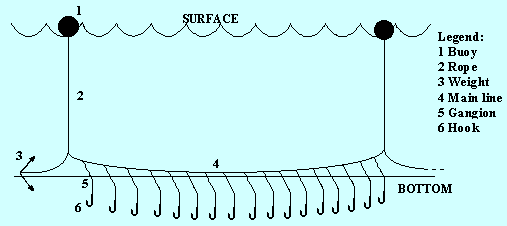
Small hook longline selectivity study - 1994-1995. DG XIV, Ref. BIOECO 93/004 Summary for non-specialistsLonglines are fixed gears which are used in Portugal and Mediterranean countries to catch seabreams (Sparidae) and other economically important species. The longline consists of a monofilament main line, to which are attached snoods or gangions at regular intervals, with a hook at the end. In a "small hook longline" the main line is usually of 1.0 - 1.1 mm diameter, the gangions are 0.5 to 1.0 m in length and are of 0.5 or 0.6 mm diameter monofilament. Gangion spacing varies according to custom and target species, but must be at least twice the gangion length in order to avoid tangling. Small hooks are used, usually size/number 13. A wide variety of baits are used, including clams, squid, small crustaceans, worms, and sardines. The entire fishing operation is manual, with the longlines being stored in tubs with approximately 300 hooks per tub. Two to three fishermen in a small boat (5 to 6m with an outboard engine) can fish 4000 or more hooks in a single set.
In this study, the primary objectives were to study the catch and size selective properties of longlines in the South of Portugal. Secondary objectives were biological studies of the species landed, evaluation of some factors affecting the catch and the sizes of the fish, and a comparison with other gear used in these small-scale, inshore, artisanal fisheries. Experimental fishing was carried out with longlines made to our specifications. For the selectivity studies, 3 hook sizes and one bait were used, with a total of 39,900 hooks fished. For the efficiency studies, 3 hook sizes, 2 gangion lengths, and 3 baits were used in a total of 16,200 hooks. The main results of the selectivity study include the following: 1) catches are highly variable, 2) diversity was high (35 species), 3) the dominant species in terms of weight was the highly valuable white sea bream (29%, for all hooks combined), 4) some species showed no differences in size selectivity (all hook sizes caught essentially the same size range), 5) species which showed some differences in size selectivity had only small shifts in the size distributions, 6) efficiency decreased sharply with increasing hook size (i.e. the larger hook caught less fish), 7) the smallest hook caught relatively more low value species, 8) practically no illegal- sized or immature fish of any species were caught. The evaluation of the three factors was generally inconclusive due to the large variability in the data. However, there was some evidence suggesting that hook size and bait is a significant combination. The biological studies provided valuable new infomation on the age structure, sex ratios, maturity, and spawning seasons for some of the more important species. This is important information for the management of fisheries. Comparison of this longline gear with gillnets showed the following: 1) species composition of the catches were significantly different, 2) hooks generally caught larger fish and a wider range of sizes than the gill nets of the mesh sizes used in this area, 3) whereas longlines caught few illegal or juveniles, even legal mesh sizes such as 60 and 80 mm stretched mesh, caught fish below the minimum legal size. With regards to the Common Fisheries Policy, this work has provided useful new information on a gear and a fishery for which there exists little data for management purposes. The information obtained will be useful for making decisions concerning gear restrictions, minimum size limits, and closed seasons. The results have confirmed that this gear has a number of characteristics which are in line with some of the objectives of the Common Fisheries Policy. These include: 1) minimal capture of undersized fish, 2) essentially no harmful effects on the environment, 3) landing of high quality product with essentially no waste, 4) no ghost fishing, 5) little or no discarding, 6) low fuel costs. NOTE: More information is included in the following report which is available from the European Comission's Directorate General XIV or from the authors
Erzini, K.; Gonçalves, J.M.S.; Bentes, L. and Lino, P.G. (1995) Small hook longline selectivity study. Final report. DG XIV, Project BIOECO 93/004. 62pp + annexes.
|