|
 |
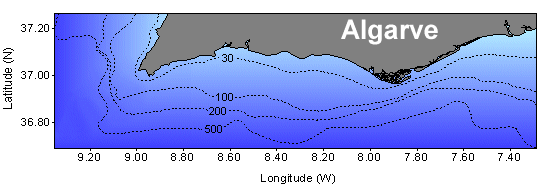
Fisheries biology and assessment of demersal species (Sparidae) from the South of Portugal - 999-2001. DG XIV, Ref. 98/082 Objectives and outline of the project:During the course of two projects on longline selectivity in the Algarve (Figure 1), from March 1994 to July 1996, preliminary biological studies were carried out on the most important species caught. All fish were sexed and the gonads classified according to a macroscopic maturity scale. The following measurements were taken for each fish captured: total length and fork length (to the lowest 0.5 cm), total weight and eviscerated weight (to the nearest 0.1g), liver weight (to the nearest 0.1g), and gonad weight (to the nearest 0.1g). In addition, otoliths (sagitta) and samples of scales were removed. Gonads were also sampled for future microscopic and histological studies.
Since there is little information available on the biology and ecology of most of the species caught in the artisanal fisheries of the Algarve, the accumulated biological material represents a valuable source of data which is potentially of considerable use for estimation of growth and mortality parameters and subsequently the management of these multi-species artisanal fisheries. For at least 7 species, we have good samples for age and growth studies on a monthly basis over one to two and a half year periods. Because the main objective of both above mentioned the projects was the evaluation of selectivity, only preliminary age determination studies based on otoliths were carried out for the following species: Boops boops, Diplodus sargus, Diplodus vulgaris, Lithognathus mormyrus, Pagellus acarne, Pagellus erythrinus, and Spondyliosoma cantharus. However, due to the size selectivity of the longline gear, juveniles and immature individuals were not caught or inadequately sampled in all cases. For this project we propose to make use of the accumulated samples for in depth biological studies of commercially important sea breams (Sparidae). As a group, sea breams account for 21% of the landings by value in the south of Portugal and 8% nationally. Additional sampling of juveniles and immature sizes will be carried out to complete the data set. Age will be attributed by counting annuli using a compound microscope and / or an image analysis system (OPTIMAS). The marginal increments will be measured in monthly sub-samples in order to validate annual ring formation. Age-length keys based on scales and otoliths will be constructed and statistically compared. The parameters of the von Bertalanffy growth curve will be estimated and the growth curves based on scales and otoliths will be compared. For each species, the results will allow us to decide which hard part (scale or otolith) is more suitable for age determination studies and to optimise the age and growth methodologies for future studies. The time and duration of the spawning season as well as size-at-maturity will be studied. These biological studies will be useful for revising current minimum landing sizes, which are considered inappropriate for most of these species. Total mortality will be estimated by means of catch curves and empirical relationships will be used to estimate natural mortality. Preliminary assessments of these stocks will be carried by means of relative yield-per-recruit analysis. These will be useful for evaluating the trend of decreasing sea bream landings over the past 10 years. To date, no assessment of the state of these valuable resources has been carried out. Summary for non-specialists:Sea breams (family Sparidae) are hermaphroditic species that are found in coastal waters world-wide. Maximum sizes range from less than 30 cm to more than 100 cm. Many species are commercially valuable and the larger sea breams are highly prized by sport fishermen (rod and line, spear fishing) and are among the most expensive fish in the market. In the Algarve, sea breams are a dominant group on the continental shelf and in lagoons and estuaries, with more than 20 species regularly caught. The Algarve fisheries are characterised by an important artisanal component, with a large number of small boats licensed to fish with a variety of gears, including gill nets, trammel nets, longlines, hand lines, jigs, traps, pots, dredges and purse seine nets. The fisheries are multi-species and multi-gear in nature and sea breams account for a significant part of the landings of many of these gears. Landings of sea breams in general and for most Sparidae species have shown a steady decline over the past ten years or more. Together with the increasing rarity of some of the larger sea breams and a decrease in mean size over time, this could be indicative of over exploitation. The only conservation and management measures in effect that are of relevance for sea breams in Algarve waters are minimum landing sizes (MLS) and technical measures such as minimum mesh sizes, amount of netting per boat and regulations delimiting fishing grounds on the basis of vessel size and gear type. Since 1994, we have been studying the artisanal fisheries of the Algarve, with a special emphasis on sea breams and the impacts of different gears on these species. Thus, a series of projects were carried out to evaluate size selectivity of longlines, gill nets and trammel nets and the recruitment of sea breams is currently being studied. During the course of these projects, biological material was collected and some preliminary fisheries biology studies carried out. The objective of the current project was to make full use of this biological material by supplementing the samples with individuals obtained from the fish market and with juveniles obtained by beach seining in the Ria Formosa lagoon. The population dynamics parameters of seven sea breams (Sparidae) from the south and south-west coast of Portugal were studied: Boops boops (bogue), Diplodus vulgaris (two-banded sea bream), Diplodus sargus (common or white sea bream), Lithognathus mormyrus (marbled sea bream), Pagellus acarne (axillary sea bream), Pagellus erythrinus (common pandora) and Spondyliosoma cantharus (black sea bream). Our objectives included obtaining monthly samples for all twelve months of the year, with at least 30 individuals per 1 cm size class for size range that would be representative of the population size structure. The ages were determined by reading and interpreting growth rings in otoliths (ear bones) and scales. A growth model (von Bertalanffy) was fitted to these data for males, females and all individuals combined in order to estimate growth parameters and comparisons were made to see if there were differences between scales and otoliths and between males and females. Validation of the age and growth methodology was carried out by marginal increment analysis for both scales and otoliths and showed that there was indeed an annual periodicity in the deposition of the growth bands in both structures in all seven species. The results of the age and growth study showed that in most cases the sea breams were rather slow growing, with several species reaching maximum ages of at least 20 years. In general, otoliths were judged to be more reliable for the determination of age in these species and consequently growth parameters based on otoliths were used for the estimation of mortality and exploitation rates and for the assessment of the state of these resources using yield per recruit analysis. Using only fish that were caught in the longline fishery and thus with known size selectivity parameters (logistic curve), the catch curve method was used to estimate total mortality. This method is based on the plot of the logarithms of the catches-at-age against age. The plot typically has an ascending limb corresponding to fish that are not fully recruited and a descending limb representing the decline in numbers due to fishing and natural mortality. The absolute value of the slope of this part of the curve is the instantaneous total mortality (Z). The natural mortality (M) was estimated using empirical formulae and the fishing mortality calculated as the difference between Z and M. The current exploitation rate was calculated as E = F/Z. The gonads of the sampled fish were analysed visually to determine sex (undetermined, hermaphrodite with the male part dominant, hermaphrodite with the female part dominant, male or female) and the maturity state. The data on the proportion mature in each size class were used to fit logistic curves and to estimate the size at maturity (L50). The seven sea breams were characterised by fairly long spawning seasons with two main groups. The first group is that of largely winter and spring spawners and consists of Boops boops, Diplodus sargus, Diplodus vulgaris and Spondyliosoma cantharus. The second group spawns from the spring to the autumn and includes Lithognathus mormyrus, Pagellus acarne and Pagellus erythrinus. The estimated sizes at first maturity (L50) were similar (17.1 ± 1.0 cm) and correspond to fish of age classes I and II. The population dynamics parameters and the longline selectivity parameters were used in yield per recruit analyses. Yield per recruit analysis is based on the consideration that yield depends on growth, age (size) at first capture and fishing mortality. It is useful for evaluating different exploitation strategies, in particular the trade-offs between small size at first capture and large size at first capture. In our analyses we evaluated a range of scenarios, varying size at first capture and exploitation rate. The results of this analysis showed that fishing and exploitation rates for these sea breams caught by longline were generally low and that they were moderately or even under exploited. It is important to note that this analysis was for longline caught fish only. The results are not surprising given the size selective properties of longlines, where the size at first capture is generally large and very few or no fish below the MLS are caught. Results of such an analysis for gears with different size selectivity characteristics would probably be quite different. In our comparative studies we have found very significant differences in the size structures of the catches of different static gears, implying very different impacts in terms of for example fishing mortality rates. Thus, since this is a multispecies, multigear fishery, the impacts of other gears must also be evaluated. For all of these gears, size selectivity should be studied and mortality rates estimated. Relative selectivity studies are necessary in order to fully evaluate the state of these valuable resources. The necessary data are not available for most of the demersal species caught in the Algarve artisanal fisheries. The report is available in PDF under request |